
The Arctic should be cooling right now, but that's not what we observe. Although global temperatures have been rising rapidly, Earth is technically still in an ice age—or more precisely, an interglacial period within an ice age. Within ice ages, there are colder periods (glacial periods) when ice sheets expand, and warmer periods (interglacial periods) like the one we're currently experiencing. Based on natural Earth cycles, we should be slowly heading toward the next glacial period over the next several thousand years. However, the carbon dioxide we've released into the atmosphere has completely disrupted these natural ice ages cycles.
About a century ago, a Serbian scientist, Milutin Milankovitch developed a hypothesis about long-term climate patterns. He proposed that changes in Earth's position and orientation relative to the Sun drive the planet's long-term climate variations and are responsible for triggering the beginning and end of glacial periods. Milankovitch identified three key orbital variations that affect how much solar radiation (insolation) reaches Earth's surface and where that radiation is distributed:
1. Eccentricity
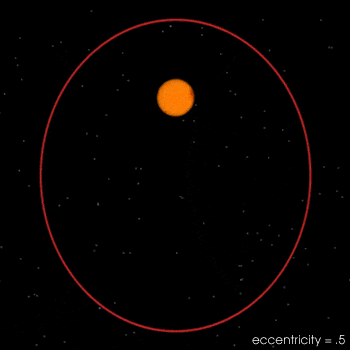
The shape of Earth's orbit around the Sun changes from nearly circular to slightly elliptical over a cycle of approximately 100,000 years. When the orbit is more elliptical, Earth's distance from the Sun varies more throughout the year, affecting seasonal temperature contrasts.
2. Obliquity
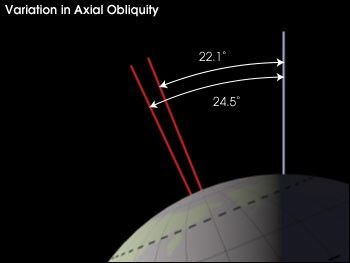
Image source: NASA/JPL-Caltech (Obliquity)
Earth's axial tilt (the angle between Earth's axis and its orbital plane) varies between about 22.1° and 24.5° over a 41,000-year cycle. Currently, Earth's tilt is approximately 23.5°. Greater tilt means more extreme seasons, hotter summers and colder winters, while less tilt results in milder seasonal differences.
3. Precession
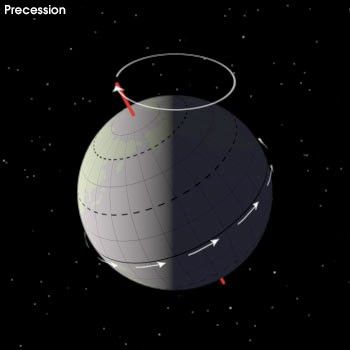
Image source: NASA/JPL-Caltech (Precession)
The direction that Earth's axis points changes over time, completing a full cycle approximately every 26,000 years. This wobble affects which hemisphere receives more sunlight during different parts of Earth's orbit, influencing the timing and intensity of seasons.
These three orbital variations don't operate in isolation. They work together, sometimes reinforcing each other and sometimes canceling each other out, creating complex patterns in Earth's climate over tens to hundreds of thousands of years. Milankovitch calculated that these combined effects should produce ice ages approximately every 41,000 years.
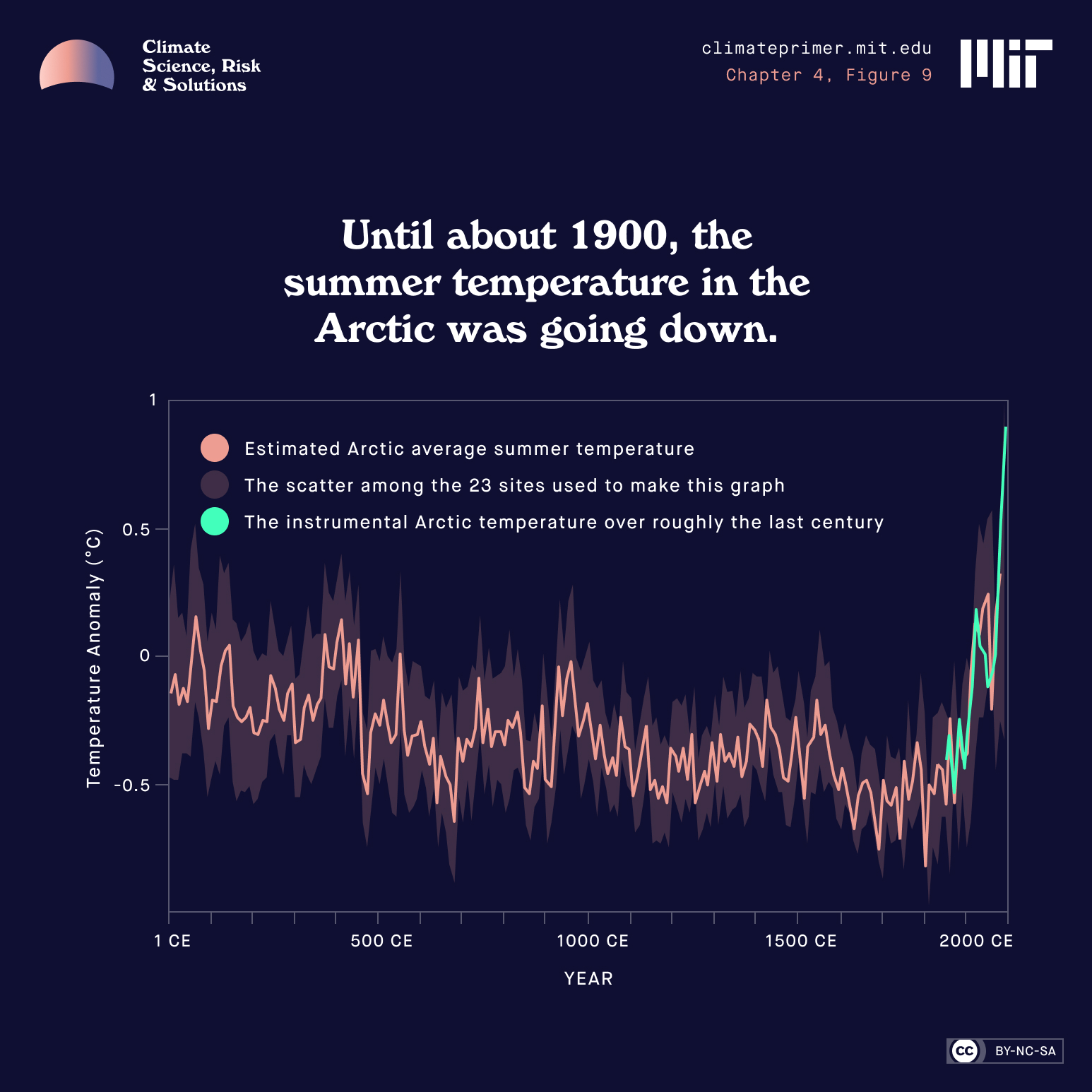
Image source: MIT Climate Primer (climateprimer.mit.edu), CC BY-NC-SA 4.0
Research has confirmed this prediction, glacial cycles did occur at roughly 41,000-year intervals between one and three million years ago, matching the obliquity cycle. However, something changed about 800,000 years ago. The glacial-interglacial cycle suddenly lengthened to approximately 100,000 years, matching Earth's eccentricity cycle instead. Scientists have proposed various theories to explain this, but we still don't have a definitive answer for why this shift occurred.
According to Milankovitch theory, we should currently be in a slow cooling phase. The orbital configuration today means the Northern Hemisphere receives slightly less summer sunlight than it did thousands of years ago. This gradual decrease in solar radiation should be slowly nudging Earth toward the next glacial period over the coming millennia.
Evidence for this expected cooling trend can be seen in Arctic temperature records. When scientists reconstruct temperatures from the past 2,000 years using ice cores, tree rings, and other climate proxies, they observe a slow, steady cooling trend from the beginning of the record until approximately 1700-1800 CE. This cooling pattern aligns perfectly with what we would expect from the Milankovitch cycles—a gradual decline in solar radiation reaching the Arctic due to Earth's changing orbital parameters.
If left uninterrupted, this natural cooling mechanism would continue for thousands of years, eventually leading to the growth of massive continental ice sheets across North America and Europe, similar to those that existed during the last glacial maximum about 20,000 years ago.
But then something unprecedented happened. Starting around 1800 CE, and accelerating dramatically after 1900, Arctic temperatures began to rise sharply. This sudden warming reversal is completely abnormal when viewed against the backdrop of the previous few thousand years of gradual cooling. The main cause is the rapid increase in atmospheric carbon dioxide and other greenhouse gases resulting from humanity's consumption of fossil fuels.
Scientists can definitively trace this CO₂ increase to human activities through multiple lines of evidence. The isotopic composition of carbon in the atmosphere has changed in ways that match the signature of fossil fuel combustion and deforestation, not natural sources. Additionally, atmospheric CO₂ concentrations have risen from about 280 parts per million before the Industrial Revolution to over 420 ppm today, a 50% increase in just over two centuries.This represents an extraordinary geological event: over the course of just a few hundred years, humans have released carbon that nature sequestered over tens of millions of years.
We remain technically in an ice age because permanent ice sheets still exist at Earth's poles. According to natural orbital cycles, we should be gradually cooling toward the next glacial advance. Instead, human emissions have not only halted this natural cooling but reversed it entirely, warming the planet at an unprecedented rate. We've essentially canceled our appointment with the next ice age, but at the cost of destabilizing the climate system that human civilization developed within.
Understanding these natural climate cycles makes the current warming even more remarkable and concerning. We're not just warming during a time when warming would naturally occur. We're warming during a time when Earth should be cooling. This isn't just climate change; it's climate disruption on a fundamental level.
We must focus on how quickly we can reduce emissions and stabilize the climate before we push Earth's systems past critical tipping points. The geological processes that regulate Earth's climate operate on timescales of thousands to millions of years. Our emissions are changing the climate on timescales of decades. That mismatch is precisely why urgent action matters.

No comments:
Post a Comment